✦ A free interactive tarot lesson
Learn the Celtic Cross Tarot Spread.
Read the whole story.
Master the ten positions, practice connecting cards, and turn a complicated tarot spread into a clear conversation—one card at a time.
The position explorer
Celtic Cross Position Meanings
This tool is only about the ten positions. Learn what each position is actually asking, how experienced readers use it, what beginners commonly miss, and which other positions change its meaning.
How this Academy reads the Celtic Cross
This is orientation, not Position 1. Cards 1–6 form the Cross; Cards 7–10 form the Staff. The Academy uses one consistent 10-card system so you can learn the spread without changing definitions halfway through a reading.
The three experienced-reader sources we reviewed do not use every position in exactly the same way. They agree on the core structure and on reading the spread as a connected whole, while differing on some names, order, and emphasis—especially Above/Below and the Staff. We preserve those differences instead of pretending there is only one legitimate Celtic Cross.
Learn the position
Start with the job of the position itself. Ask what kind of information this place in the spread is meant to reveal before you worry about a specific tarot card.
Place the card inside it
Take the card’s possible meanings and narrow them through the position. A traditionally positive card can still be difficult in a Challenge position; a difficult card can reveal something useful in the Present.
Connect the positions
Do not read ten isolated boxes. Read 1 + 2, Past → Present → Near Future, Above ↕ Below, Self ↔ Environment, and the other relationships that make the Celtic Cross a story.
Revise the story
Your first interpretation is provisional. Later cards can confirm, narrow, or change what an earlier card seemed to mean. That is part of reading the spread, not a mistake.
Card practice
Shuffle the Celtic Cross
This tool is only for practicing tarot-card interpretation inside the spread. The Position Meanings tool is separate so this one can go much deeper on the actual 78 cards.
Deal a Practice Spread
Draw ten unique cards from the full 78-card deck.
Start with the card
Look at the imagery
How the energy can show up
Now place it here
Don’t jump to
Ask yourself
A practical alternative to printing
Keep the Entire Celtic Cross in Place
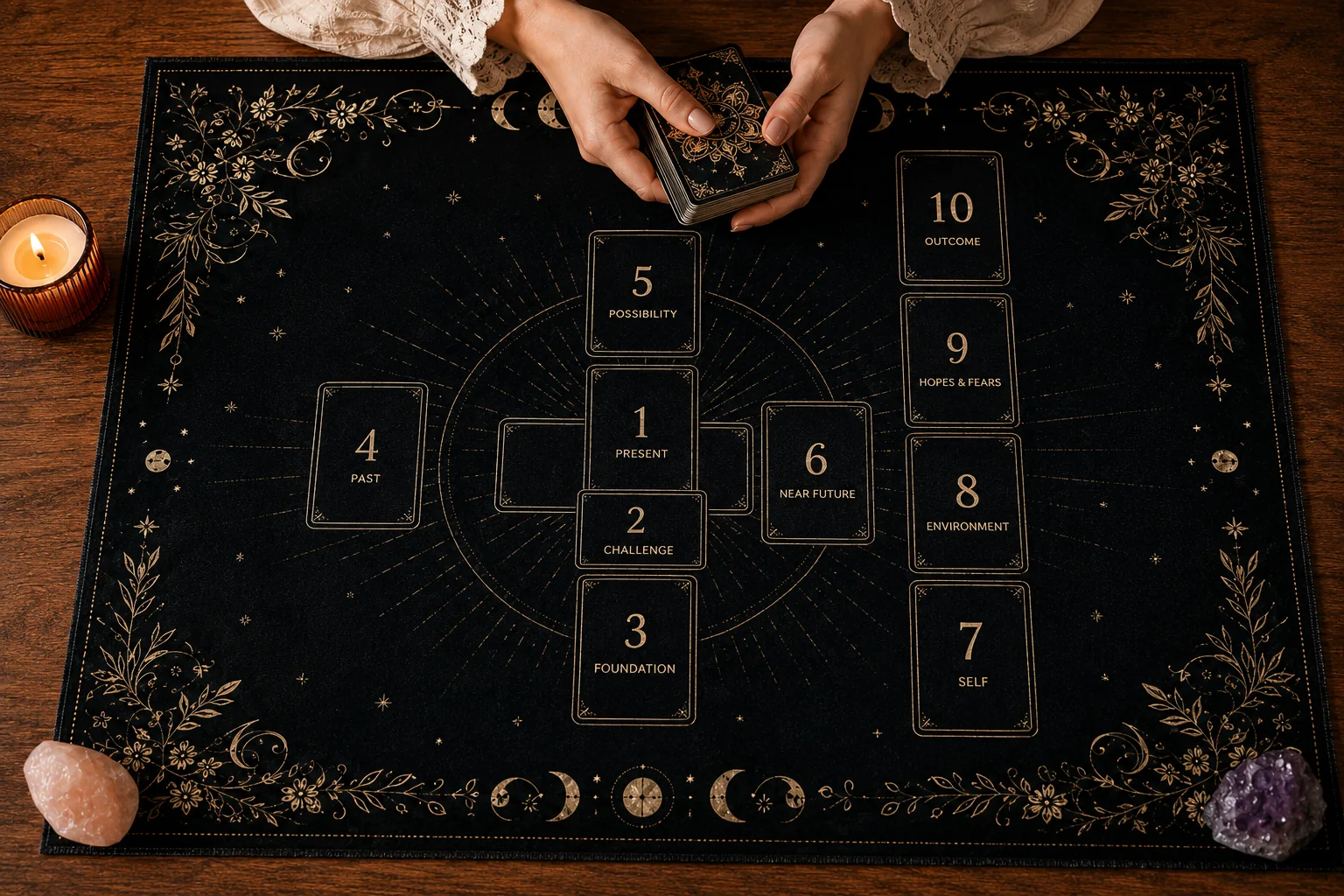
A position-marked Celtic Cross reading cloth gives every card a clear place, protects your deck, and makes the ten-card layout easier to follow without repeatedly checking a diagram.
- See all ten positions
- Protect your cards
- Reuse for every reading
As an Amazon Associate I earn from qualifying purchases.
Continue learning with guided instruction
Recommended Celtic Cross Tarot Courses
These programs were selected for practical instruction that can help you move from memorizing individual cards to interpreting complete tarot readings with greater confidence.
TarotNav: A GPS for Life
Learn Linda Marson’s practical TarotNav method through recorded lessons, a complete 78-card reference book, a reading journal, and step-by-step video demonstrations of the Celtic Cross and Horseshoe spreads. Recommended for readers who learn best by watching complete spreads interpreted in action.
- 22 recorded Major Arcana lessons
- Complete 78-card e-book and personal workbook
- Celtic Cross and Horseshoe video walkthroughs
- Self-paced study with lifetime access
Master Tarot Reading Fast
A substantial beginner-to-reader program covering deck preparation, the Major and Minor Arcana, intuitive interpretation, reading patterns, and a dedicated Celtic Cross lesson explaining all ten positions. Recommended for learners who want one extensive step-by-step course.
- 112 video lessons
- Deck bonding, cleansing, and preparation
- Major and Minor Arcana instruction
- Dedicated ten-position Celtic Cross lesson
Accredited Tarot 101
A structured foundation covering the full deck, court cards, suits, symbolism, numerology, astrology, deck care, intuitive interpretation, and common spreads. Recommended for beginners who need stronger card knowledge before concentrating on a complex layout like the Celtic Cross.
- 36 structured video lessons
- Major Arcana, Minor Arcana, and court cards
- Symbolism, numerology, and astrology
- Common spreads and intuitive interpretation
Affiliate disclosure: We may earn a commission when you enroll through these links, at no additional cost to you. Course features and availability can change; review the provider’s current details before purchasing.
Common questions
Celtic Cross Spread FAQ
Use these answers as a practical reference while learning how to lay out, interpret, and connect all ten cards in a Celtic Cross tarot reading.
How many cards are in a Celtic Cross reading?
The traditional Celtic Cross uses ten dealt cards. Some readers place an additional significator beneath the first card to represent the person or central theme, but a significator is optional and is not required for a complete reading.
What are the ten Celtic Cross card positions?
The positions represent the present situation, the challenge, the foundation, the recent past, possibilities or conscious goals, the near future, your approach, your environment, hopes and fears, and the likely outcome. The position supplies the context that turns a general card meaning into a specific message.
Is the crossing card automatically reversed?
No. The second card is placed horizontally because it crosses the first card and represents the challenge or modifying influence. Its sideways placement does not automatically make it reversed. Decide whether it is upright or reversed based on how it was drawn.
Is the Celtic Cross spread suitable for beginners?
Yes, but it is easier when learned in sections. Start with Positions 1 and 2 to understand the central tension. Add Positions 3 through 6 to build the cross, then read Positions 7 through 10 as the staff. Connecting these groups is less overwhelming than treating the spread as ten unrelated cards.
What questions should I ask a Celtic Cross spread?
Ask open questions such as “What should I understand about this situation?” or “What influences should I consider before deciding?” Open wording allows the cards to explore causes, choices, obstacles, personal attitudes, outside influences, and possible direction instead of forcing a simple yes-or-no answer.
Can I use the Celtic Cross for love and relationship readings?
Yes. A relationship-focused Celtic Cross can reveal the current dynamic, underlying causes, past influences, expectations, outside pressure, fears, available choices, and the direction the relationship may take. Keep the question centered on understanding and decision-making rather than trying to control another person.
Do I have to use reversed tarot cards?
No. Reversals are optional. Beginners can read every card upright and allow its position and surrounding cards to provide nuance. If you use reversals, consider whether the card’s energy is blocked, delayed, weakened, internalized, excessive, or being expressed in an unexpected way.
How far into the future does a Celtic Cross reading predict?
The spread has no universal time limit. Choose a time frame before shuffling, such as the next month, three months, or six months. Position 6 usually describes the next development, while Position 10 shows the broader direction if the current pattern continues.
What does the outcome card mean?
Position 10 represents the most likely direction under the present circumstances. It is not unavoidable fate. New information, changing circumstances, and different choices can alter the outcome. Read it alongside the present, possibilities, near future, and your approach.
How do I connect all ten cards into one reading?
Look for repeated suits, numbers, court cards, Major Arcana, reversals, symbols, and visual similarities. Read Positions 4, 1, and 6 as a timeline. Compare the foundation with the possibilities, and compare your approach with the environment. Finally, connect the outcome back to the present and the choices shown throughout the spread.
What if the Celtic Cross cards seem to contradict each other?
Apparent contradictions often reveal the most important tension in the reading. One card may describe what you consciously want while another shows an unconscious influence, external pressure, or fear. Use the positions to determine why the two messages differ instead of forcing them to agree.
How often can I perform a Celtic Cross reading?
You can read whenever a situation meaningfully changes or you need a new perspective. Repeating the same question too frequently can create confusion and encourage searching for a preferred answer. Record the reading, allow time for events to develop, and return when circumstances or your available choices have changed.
Reader’s note: Tarot is best used for reflection, learning, and exploring choices. A reading should not replace professional medical, legal, financial, or mental-health advice.